OAuth DCR in MCP Servers: Great DX, Real Security Debt
While building MCP servers, I found ChatGPT's OAuth Dynamic Client Registration surprisingly helpful for third-party onboarding. It also exposes a new class of security and governance risks worth discussing.
When I was building an MCP server recently, one design choice stood out to me: ChatGPT supports OAuth Dynamic Client Registration (DCR).
At first glance, this feels like a major win for developer experience. In third-party integrations, DCR removes a lot of manual coordination and makes connection setup much faster.
But after implementing and threat-modeling the flow, I also felt this is exactly the kind of feature that can quietly introduce security debt if we treat it as “just a convenience layer.”
This post is my first-pass framing of why DCR in MCP is exciting, where it can fail, and what guardrails I now consider non-negotiable.
DCR flow in an MCP integration
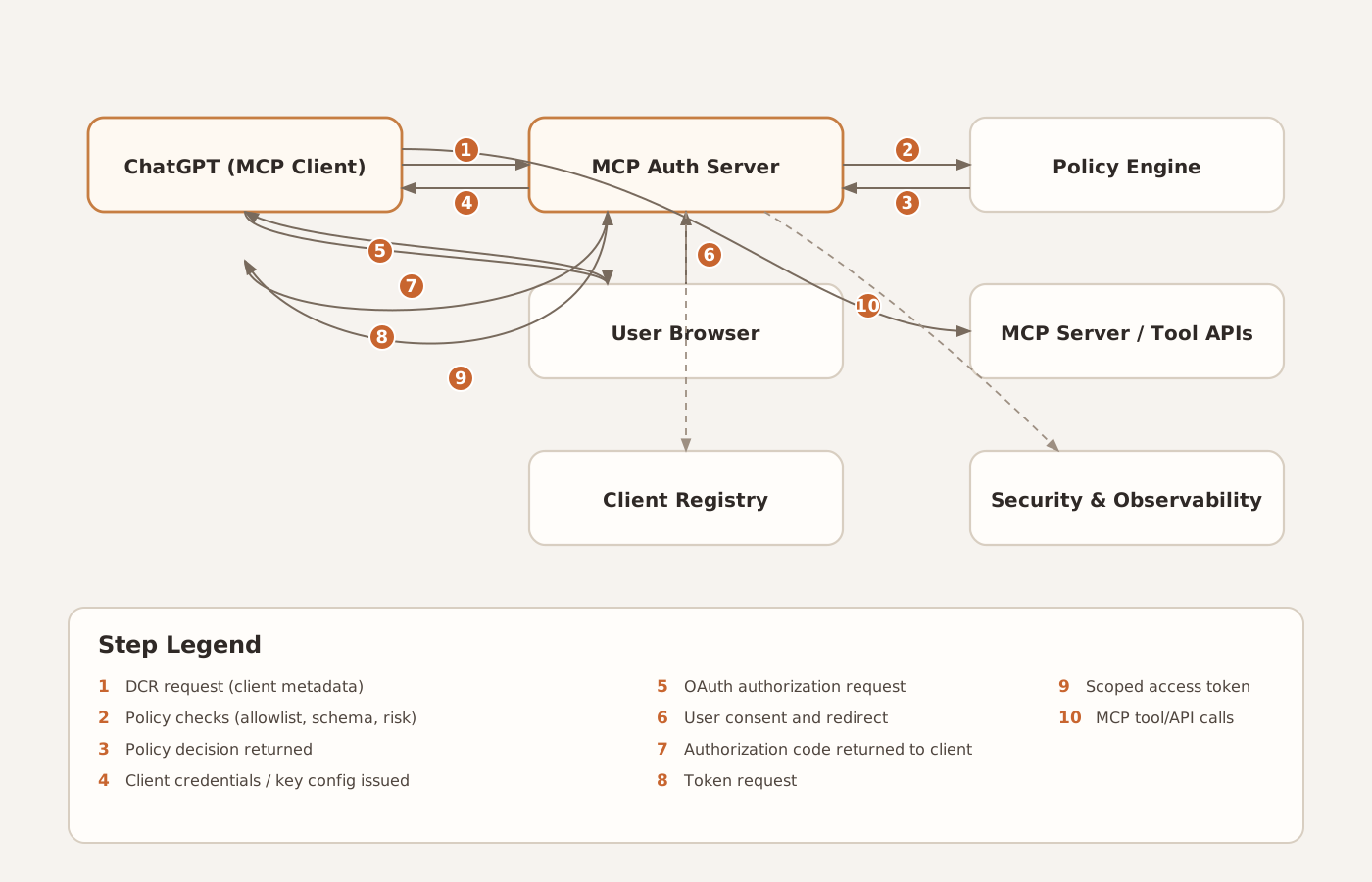
The key thing to notice is that DCR is not an isolated API call. It is the front door to your trust lifecycle.
Why DCR feels so good in MCP integrations
Traditional OAuth onboarding usually requires pre-registration, dashboard setup, and credential exchange before anything useful can happen.
In MCP-style third-party connection flows, that friction is amplified because:
- Tool ecosystems evolve quickly.
- Integrations are often exploratory before they become critical.
- Teams want to reduce human-in-the-loop setup work.
DCR helps by enabling runtime client registration with standardized metadata. That means a client can register, discover capabilities, and start auth flow setup with much less back-and-forth.
From a product perspective, this is huge:
- Faster onboarding for new tools.
- Fewer operational tickets.
- Better self-serve experience for partner teams.
Where the risk appears
The same flexibility that improves onboarding can also weaken control planes if not constrained.
1) Client sprawl and trust inflation
If registration is too open, you quickly lose a clean trust boundary. You may end up with many semi-trusted clients that all look “valid” in logs.
2) Metadata abuse
DCR accepts client metadata (redirect URIs, grant types, auth methods, etc.). Without strict validation, this becomes an attack surface, not just configuration.
3) Weak lifecycle governance
A registered client is an identity artifact. If you do not enforce expiration, rotation, and revocation policy, temporary integrations become long-lived privileged actors.
4) Observability gaps
In many teams, DCR success is measured only by “it connected.” That ignores whether the registration event was expected, policy-compliant, and auditable.
Guardrails I would use by default
For MCP server deployments, I now treat DCR as a privileged operation and apply constraints early.
Policy gate before registration acceptance
DCR requests should pass a policy engine before persistence. At minimum:
- allowlist/denylist checks,
- metadata schema validation,
- environment-specific constraints,
- risk scoring.
Scope minimization and audience binding
Newly registered clients should start with narrow defaults. Scope expansion should require explicit policy checks, not implicit trust from successful registration.
Time-bound credentials and registration TTL
Client registration should have lifecycle semantics. If a client is inactive or unverified beyond a window, downgrade or disable it automatically.
First-class audit events
Treat registration, update, and delete as security events. Emit structured logs with actor, metadata diff, policy decision, and correlation IDs.
A useful mental model
DCR is not “auto-config for OAuth.” In MCP environments, it is closer to identity provisioning at runtime.
When framed that way, design priorities become clearer:
- Developer experience matters.
- But trust establishment, least privilege, and lifecycle governance matter more.
Closing thought
I still think ChatGPT supporting OAuth DCR for MCP is a strong design choice. It removes real friction in third-party integration and makes the ecosystem more usable.
The key is to avoid celebrating convenience without budgeting for control. DCR is excellent, as long as we treat it as a security-sensitive provisioning workflow rather than a simple onboarding shortcut.